Aim & drop
Move the little ship, find a clear space and release the waiting planet.
Game design · Character art · Development
A calm space puzzle where matching planets turns play into a small moment of discovery.
The idea
Play. Merge. Learn.
Planet Merge is a learning-first game prototype for children aged 5–10. Players drop matching characters into a container, combine them into the next planet, and slowly build their way through the solar-system-inspired collection.
I created the complete experience: the game concept, mechanics, character family, interface, physics, sound interactions and parent controls. The result is intentionally easy to understand and gentle enough for independent play.
Core interaction
One rule. Immediate feedback.
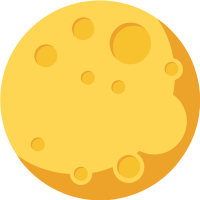
 MoonMoon
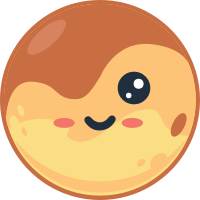 Pluto
PlutoMove the little ship, find a clear space and release the waiting planet.
Two identical characters touch and combine into the next body in the sequence.
New planets join the collection, with selected discoveries adding a replayable audio explanation.
Character system
A growing little universe
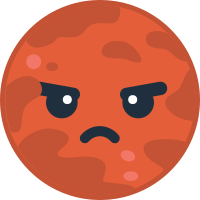
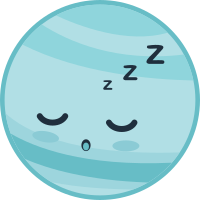
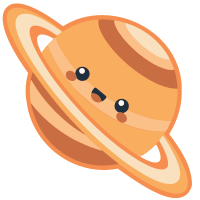
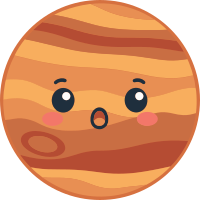
Every planet was illustrated as a friendly character with its own colors, surface details and personality. Size is part of the game language: each successful merge feels visibly more important.






Playable characters
Choose your pilot
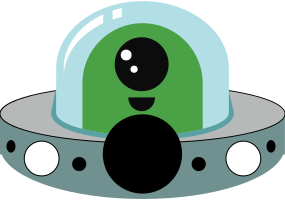
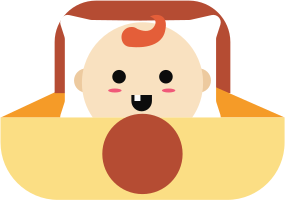
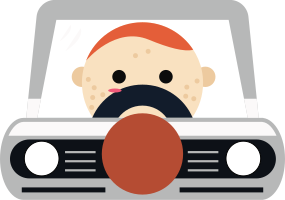
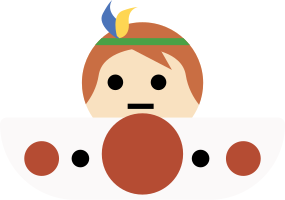
Before each run, children can choose one of four original pilots. Each skin keeps the same circular planet holder, so personality changes without changing how the game is played.
Character reactions
The characters feel the game
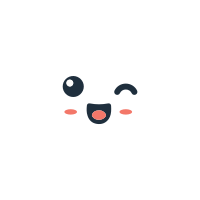
Planets react when they are hit. A character flinches, looks a little sad, then relaxes again. These expressions turn collision feedback into something a child can read without instructions.



Educational rewards
Knowledge as a reward
Discovery is tied directly to progress. New planets become collectible perks, while selected discoveries include a simple spoken explanation. The audio system can grow across the full lineup.
Home, blue and bold. Two Earths fuse into Uranus.
Healthy play
Play on the parent's terms
Parents can set a daily play-time allowance and protect it with a four-digit PIN. When the allowance is used, the current round can finish naturally, but a new one cannot begin.
Design principles
Low pressure by design
The experience avoids the patterns that make many children's games hard to leave. There is no advertising, no purchase loop, no daily streak and no countdown pushing the player to hurry.
Children can think, aim and learn at their own pace.
Progress comes from understanding the game, not spending.
No chat, public leaderboard or account is needed to play.
Daily limits make the end of play clear and predictable.
Game systems
Simple surface, thoughtful depth
Three merges from one drop lets the child time and choose the next planet.
Five merges activates a clear visual power that removes one planet type.
A gentle board shake can rescue a stack, protected by a rainbow in early levels.
Creating two Suns completes the level, unlocks the next challenge and keeps the run going.
From design to code
Built beyond the mockup
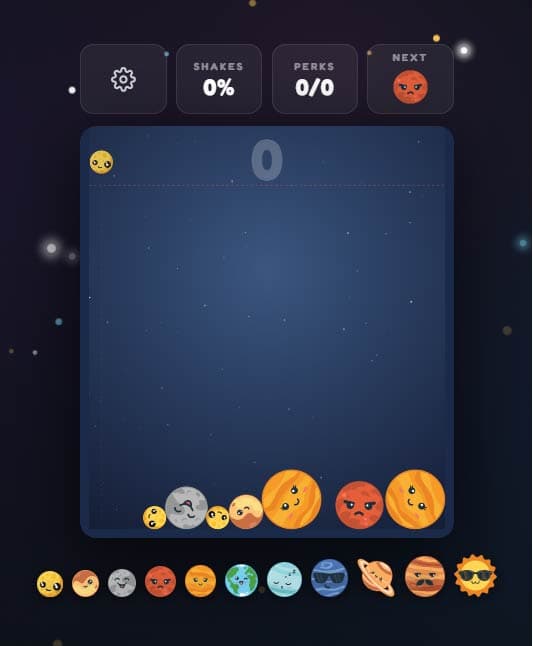
The prototype runs directly in the browser, with touch and mouse controls, persistent progress, responsive performance and a tuned physics system.
My contribution
One project, every layer
Audience, learning goal, game rules and progression.
Twelve characters, expressions, ship skins and visual effects.
Child-facing interface, feedback states and parent settings.
Physics, rendering, responsive controls, audio and saved progress.
Made to feel like play.
Built to leave a little knowledge behind.
More work